
Maternal Health
Inequities in our healthcare system perpetuate systemic barriers that result in both challenges and negative health outcomes for many expectant parents and birthing people. We’re working to redesign the systems and policies that shape maternal care, with doulas leading the way, so that every family has access to the support they need to thrive.

The Challenge
Maternal health inequities in the U.S. are serious, persistent, and largely preventable — and they fall hardest on Black, low-income, and Medicaid-covered birthing people. Racial discrimination, fragmented care, and systems not built for the communities they serve all contribute to preventable harm. Community-based doulas are one of the most powerful tools we have to address these disparities — yet even as states have begun to reimburse doula care, too many families still can’t access it.
By the Numbers
Two times
Black women are more than twice as likely as white women to experience infant mortality in the first year of life.
Four times
Black women in the U.S. are four times more likely to die during pregnancy and childbirth than white women.
Four in five
pregnancy-related deaths in the U.S. are preventable.
Our Goal
Our goal is a future where every birthing person, regardless of income, race, or zip code, has access to a community-based doula. We work with health systems, state agencies, and communities to build the policies, workforce, and care environments to make this future possible – with doulas leading every step of the way.
Our Work
Increasing Access to Doula Services in New York Communities
Health Leads convenes and facilitates the New York Coalition for Doula Access (NYCDA) to increase doula access and care among Black and low-income patients. NYCDA’s advocacy efforts helped secure inclusion of Medicaid coverage for doula care in New York State’s FY24 budget, and Health Leads now serves as a liaison between the doula community and the New York State Department of Health to help ensure doulas are centered in implementation of the benefit.
Building Doula-Friendly Clinical Environments
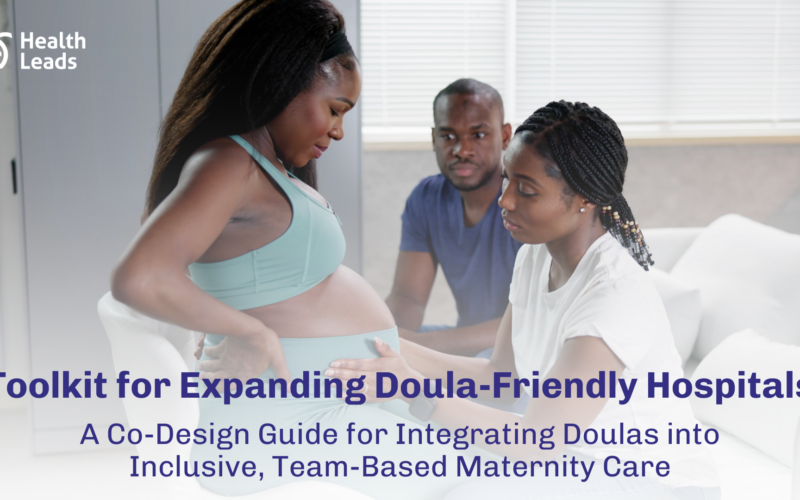
With support from the Mother Cabrini Health Foundation, Health Leads is piloting a doula-friendly hospital framework in New York — co-designed with doulas and clinicians — to test what genuinely supportive hospital environments look like in practice, with the long-term goal of a statewide designation. In Massachusetts, we’re convening hospitals to surface bright spots, address barriers, and co-design policies that support doulas as part of the care team.
Strengthening the Doula Workforce In Massachusetts
In partnership with the Massachusetts Department of Public Health, Health Leads is facilitating a statewide Doula Community of Practice — building peer connection, supporting doulas in navigating MassHealth enrollment and reimbursement, and centering doula leadership in the design of state systems.
Connecting Families to Doula Care Through Community Health Centers
In Boston, Lowell, and Brockton — communities with high Medicaid birth volumes and significant racial health disparities — Health Leads is forging partnerships between Federally Qualified Health Centers and community-based doula organizations. The goal is to ensure that families in the communities most impacted by maternal health inequities are proactively connected to a doula through the care providers they already trust.
Our Impact

Streamlining access to WIC and SNAP benefits
Our findings will inform statewide strategies to continue increasing enrollment.

Establishing a living wage standard for NYC doulas
A statewide Medicaid reimbursement helps more individuals become doulas.

Implementing standards for doula-friendly hospitals
Allows patients and doulas to know they’re in good hands.

Connecting clinics and communities
We’re making it easier for parents to access resources and support.
Partners


Related Resources
View All

For partnership and investment opportunities
Sylvia Koodrich
Vice President, Business Partnerships & Investor Relations